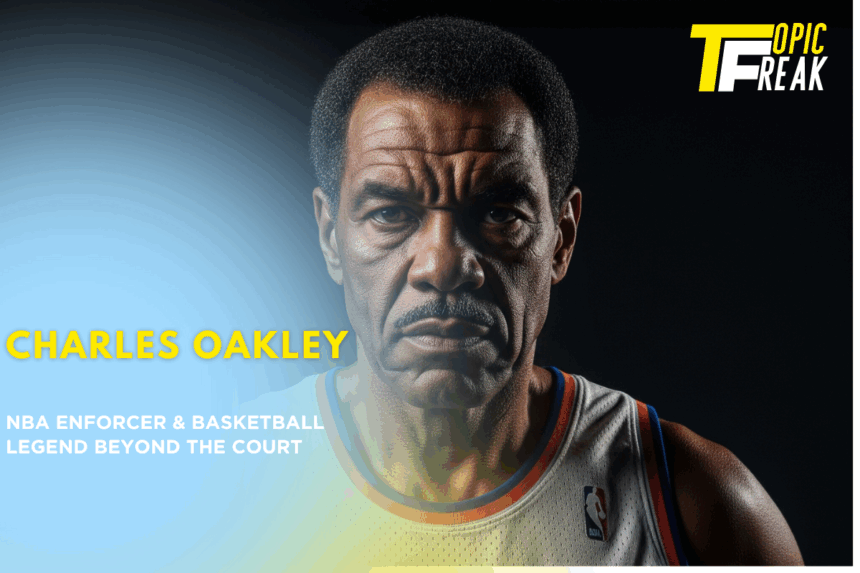
Some names in the world of professional basketball stand out not just for their work and stats but for the golden heart, toughness, and grit that they brought to the game. The people who gave their lives to their professions. These players not only play for their country, but they also lead. They protected and became the heart and soul of their teams. One such player explained what being raw and tough in the NBA meant.
When you think of power, honesty, and an unbreakable and unshakeable presence on the court, one name rises to the top: Charles Oakley.
Who is Charles Oakley?
He is much more important than a normal NBA player; he’s a symbol of hard work, honesty, and flexibility as a professional basketball player. Well-known as the “enforcer” of the ultimate league. He established a career in stones, leadership, and defense. He was someone teammates could rely on and rivals never wanted to cross.
In this article, you will study about his early life, education , status, career, controversies, teams, stats and post retirement legacy. We will explore why the name of Charles Oakley resonate in NBA circles
Early Life and Career
On December 18, 1963, Charles Oakley was born in Cleveland, Ohio. He was growing up in a working middle family. He adopted a strong working habit at an early age. His journey to the NBA was not easily paved with hype but fairly built on tenacity and performance.
In his senior year, he took part in Virginia Union University, a Division II Historical Black Colleges and Universities (HBCU), where he predominated with 17 rebounds and 23 points per game. His outclass performance caught the eye of NBA scouts, which led to his selection in the 1985 NBA Draft.
Early years in NBA Draft
He was selected by the Cleveland Cavaliers in 1985 NBA Draft as the 9th overall pick. However, his rights were immediately replaced to the Chicago Bulls, where he would begin his professional career.
Career in Chicago Bulls (1985–1988)
In Chicago, he quickly earned the honor of being Michael Jordan’s bodyguard on the court, while Jordan handled the scoring and Oakley participated on the physical side of the game and securing rebounds, setting screens, and any opponent who dared challenge his teammates.
Bull Stats
- 10 rebounds per game and 12.4 points Averagely
- Played every game for continually three seasons
- Ranked among the top rebounders in the league.
Time spending in Chicago set the tone for the rest of his career: high impact, high effort, low scenes.
The New York Era (1988–1998)
For the center Bill Cartwright, In 1988, Oakley was moved to theNew York Knicks. It was the biggest surprise for the fans because they didn’t expect his move, it proved significant for the Knicks. He became the heart and soul of a team known for his defensive mind, blue-collar, and defensive identity.
Knicks Highlights
- Formidable frontcourt was formed with Patrick Ewing
- Key player in multiple runs
- Final appearance in 1994 NBA (Knicks lost to Houston Rockets)
- 1994, got selected for the NBA All-Star Game.
He gave 10 rebounds per season continuously and became a fan favorite at Madison Square Garden.
Raptor, Bulls and Rockets
After a long time in New York, in 1998, he was moved to the Toronto Raptors. As he grew older, he became a man of leadership to a young rooster having Vince Carter and Tracy McGrady.
Later on, he had little stints back with the Chicago Bulls and the Houston Rockets.
He retired from the NBA in 2004.
Career Stats:
- Total 1,282 games played
- Total rebounds 12,417 (11th all-time at retirement)
- 9.5 rebounds and 9.7 points per game (career average)
Playing style and legacy
He wasn’t showy, and he wasn’t a public figure. But he was a game-changer in all senses.
- Rebounding: Top 10 in rebounds multiple seasons with 9.7 points
- Defensive mind: Guarded some of the best power of defense all time.
- Reliable: Never missed games due to injury.
- Man of Leadership : lead teammates accountable and held by example.
Every winning team needs the one who does the difficult tasks night after night. He was that kind of person because of his defensive minded identity.
Off-Court Controversies
His reputation for determination wasn’t limited to the basketball court. His most high profile clashes are also notable after retirement.
Madison Incident (2017):
In one of particularly talked-about incidents in recent NBA memory, he was forcefully expelled and imprisoned at Madison Square Garden during a Knicks game. The event arose from disagreements between Oakley and Knicks owner James Dolan.
He said he was unduly targeted, while the Knicks charged disruptive behavior. The dispute sparked considerable criticism against the organization and solidified Oakley’s role as an aspect of the “old-school Knicks” culture that fans sadly miss.
Life After Basketball
Charles Oakley didn’t fade from the public eye after his playing days. Instead, he pivoted to business and philanthropy.
Oakley’s Enterprises:
- A successful catering business, Oakley’s Gourmey BBQ
- Reality shows appearance like The Last Dance and Big3
- Works with youth organizations to guide inner-city children
- In 2022, Published his autobiography “The Last Enforcer”
His off-court success is an example to the same discipline and grit he brought to the hardwood.
Cultural Impact
Few players have replaced their roles as enforcers to become icons. But Oakley’s influence can’t forgot:
Basketball culture: Symbol of toughness, honesty, and defensive mentality
Lyric Industry: Frequently mentioned in hip-hop lyrics ( by Jay-Z)
Media: Appearances, interviews, and broadcasts
Today’s age young players mostly cite him as an example of uncompromising professionalism and unexplained work ethic.
Final Thoughts:
The most reputed figure in NBA history remains one that is Charles Oakley. His accomplishments aren’t measured by only MVP trophies or scoring titles but by the honor he earned from coaches, teammates, and even opponents. Oakley’s stands as a symbol of old school basketball values in an era where toughness is mostly undervalued. His honesty, hard work, and unflinching courage bore fruits.
Reading Recommendations:
John Frusciante: The Sound Behind RHCP’s Iconic Eras
The Legacy of Tom Golisano: Business & Philanthropy
Why Does George Foreman Trust Choice Home warranty? And Why Should You Too?